
Vedant Puri
PhD Candidate, Carnegie Mellon University
Efficient Transformer Architectures | Scientific Machine Learning
I design transformer architectures with explicit attention to scaling and memory efficiency. My recent work, FLARE, enables million-token regimes on a single GPU. I implement new architectures directly in PyTorch and Triton. My background spans high-performance computing, numerical analysis, and computational fluid dynamics.
Research Interests
- Efficient attention architectures
- Numerical methods for ML and for PDEs
- Scientific machine learning
Featured Work
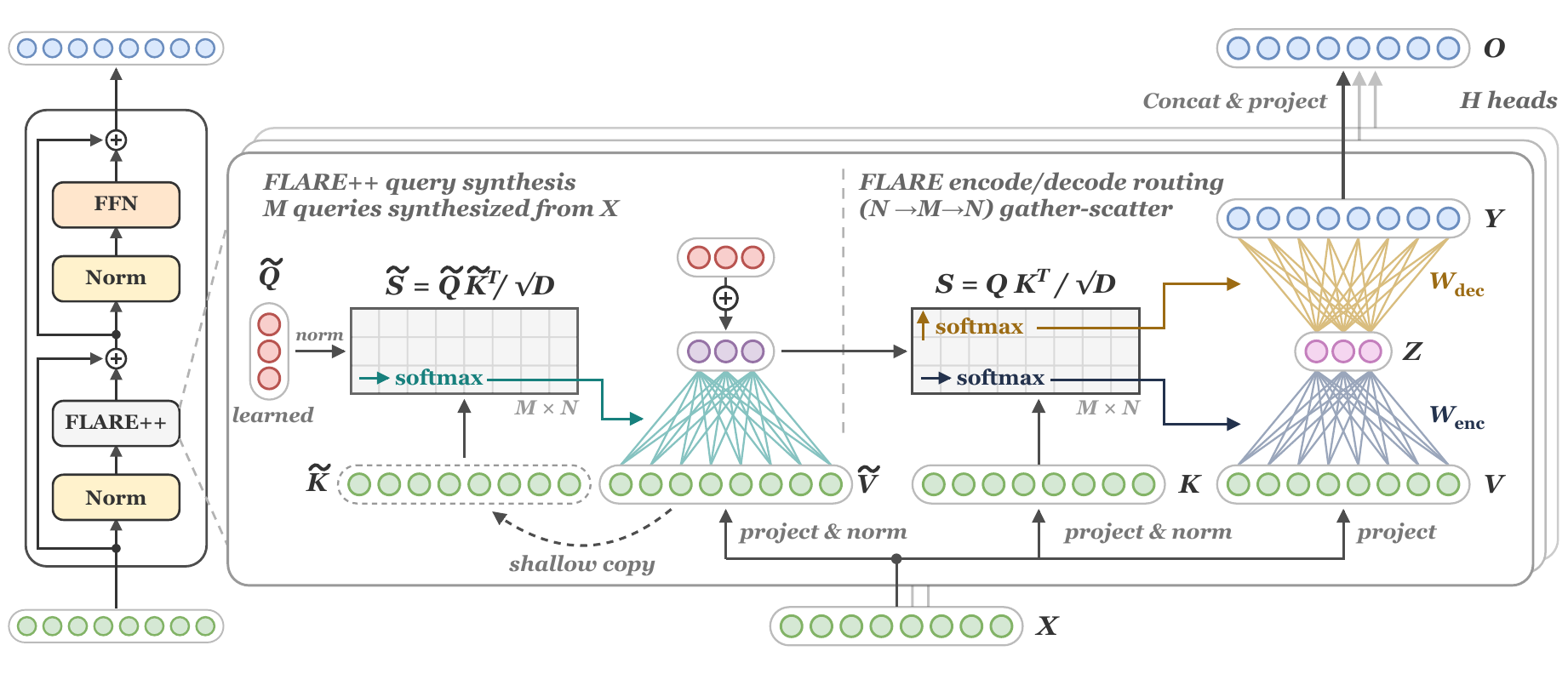
FLARE++ - Low-rank attention with attention-synthesized routing
- Made FLARE’s compression template input-aware: one extra attention call synthesizes the routing queries from the current input.
- Preserved low-rank structure and linear cost in sequence length using only standard fused SDPA calls, with no custom kernel.
- Built exact multi-GPU context parallelism that shards tokens across devices, enabling single-pass inference on the 8.2M-cell DrivAerML car surface.
- Reduced FLARE’s error by 25% on average across five PDE benchmarks and raised Long Range Arena average accuracy by 3.5%.



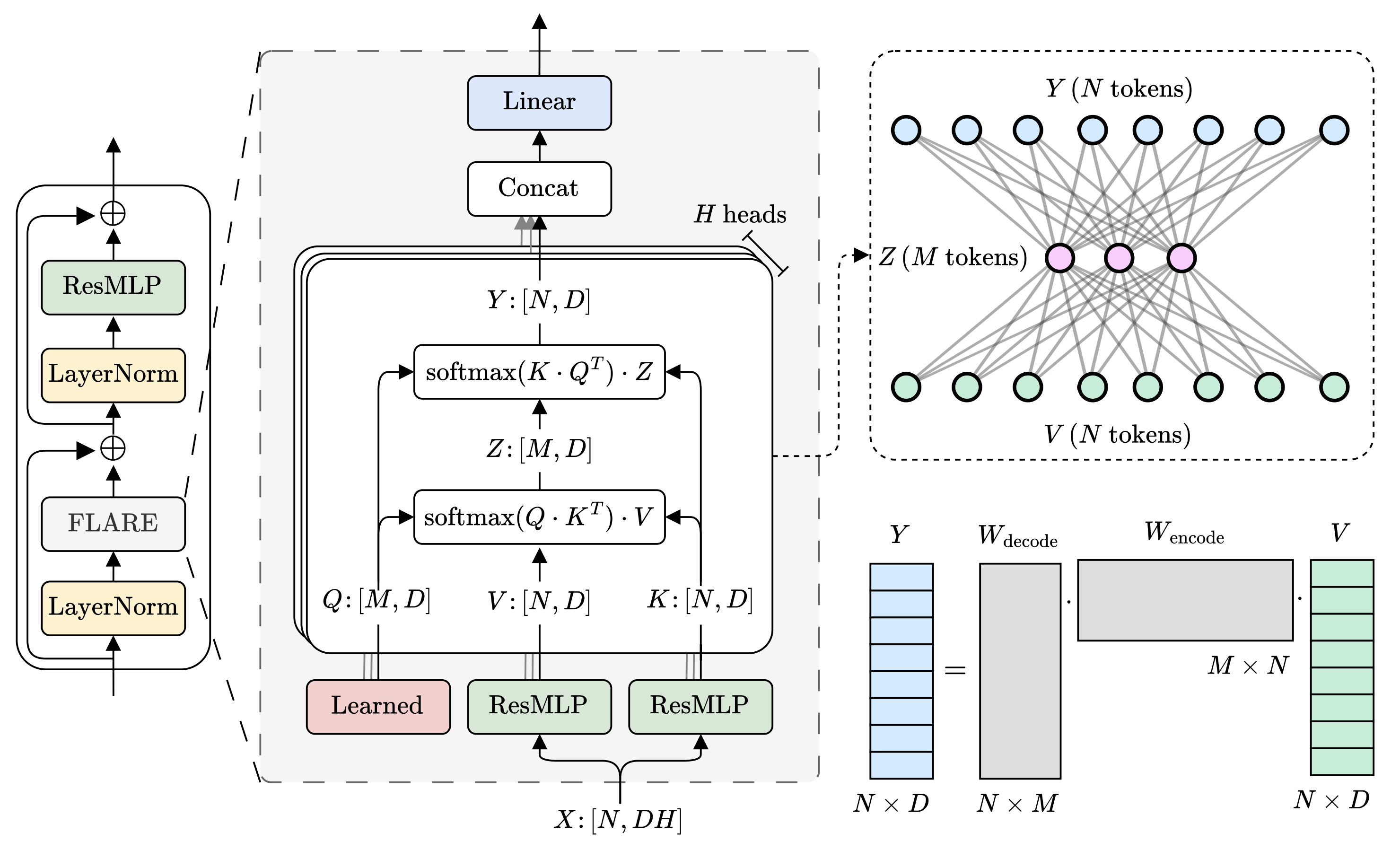
FLARE - Fast Low-rank Attention Routing Engine
- Derived a flexible low-rank reformulation of self-attention via latent routing.
- Reduced quadratic complexity of global communication in self-attention to linear complexity.
- Demonstrated scaling to 1M tokens on a single H100 GPU, attaining over 200x speedup over vanilla self-attention.
- Implemented attention modules in PyTorch and Triton with reproducible scaling experiments.
- Evaluated across PDE surrogate modeling, NLP, and vision benchmarks.



FLARE for Language Modeling (Ongoing dissertation work)
Decoder-only architectures | 2025–Present
- Extending FLARE to decoder-only next-token prediction with causal attention.
- Enabling adaptive attention state size to control memory and compute during training and inference.
- Implementing fused Triton kernels for causal training, prefill, and decode.

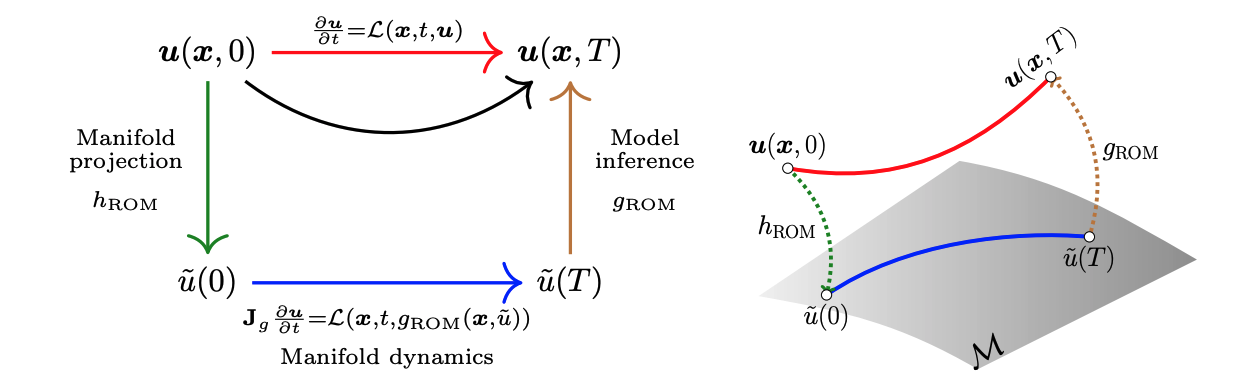
Hybrid equation-based + data-driven PDE modeling framework
- Introduced smooth neural fields as nonlinear spatial ansatz functions in equation-based reduced-order modeling.
- Retained physics-based Galerkin time evolution while learning expressive low-dimensional representations.
- Attained 200x speedup over full-order simulations in transport-dominated regimes.



Previous Work: Computational fluid dynamics on HPC systems
I previously worked on turbulence simulation and analysis workflows in high-performance computing settings, with emphasis on spectral element methods and large-scale post-processing. This background in numerical methods and PDE solvers informs how I design stable and efficient transformer architectures for scientific ML.
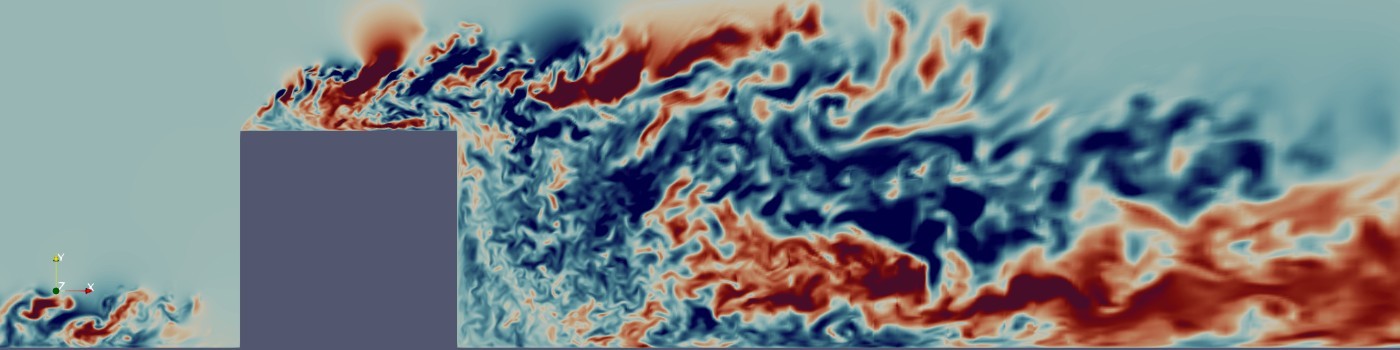 Velocity magnitude for flow past wall-mounted cube case at Reynolds Number 3900 with respect to cube height. Computation performed using spectral element code NEK5000 at Argonne Leadership Computing Facility.
Not Work
Not So Up-to-Date Photography Portfolio
For the past decade, I have used a Canon DSLR as an excuse to walk around and photograph people, geometry, and city texture.
Hobbies
- Sports: squash, golf, crossfit
Open Source
FLARE
Fast Low-rank Attention Routing Engine for scalable transformer attention.
mlutils.py 
Lightweight PyTorch project template and utility toolkit for ML experiments.
Julia Open Source Tools
SciMLOperators.jl 

Operator abstractions for SciML and PDE workflows
LinearSolve.jl 

Linear solver interface for scientific machine learning
Below is a nonexhaustive list of Julia projects that I have contributed to.


KolmogorovArnold.jl 
Julia implementation of Kolmogorov-Arnold Networks with custom gradients for faster training.
FastDiffusion.py 
Experiment with trigonometric noise schedule in context of few step diffusion.
NekTools 
FORTRAN 77 utilities for turbulence statistics and post-processing in NEK5000.